


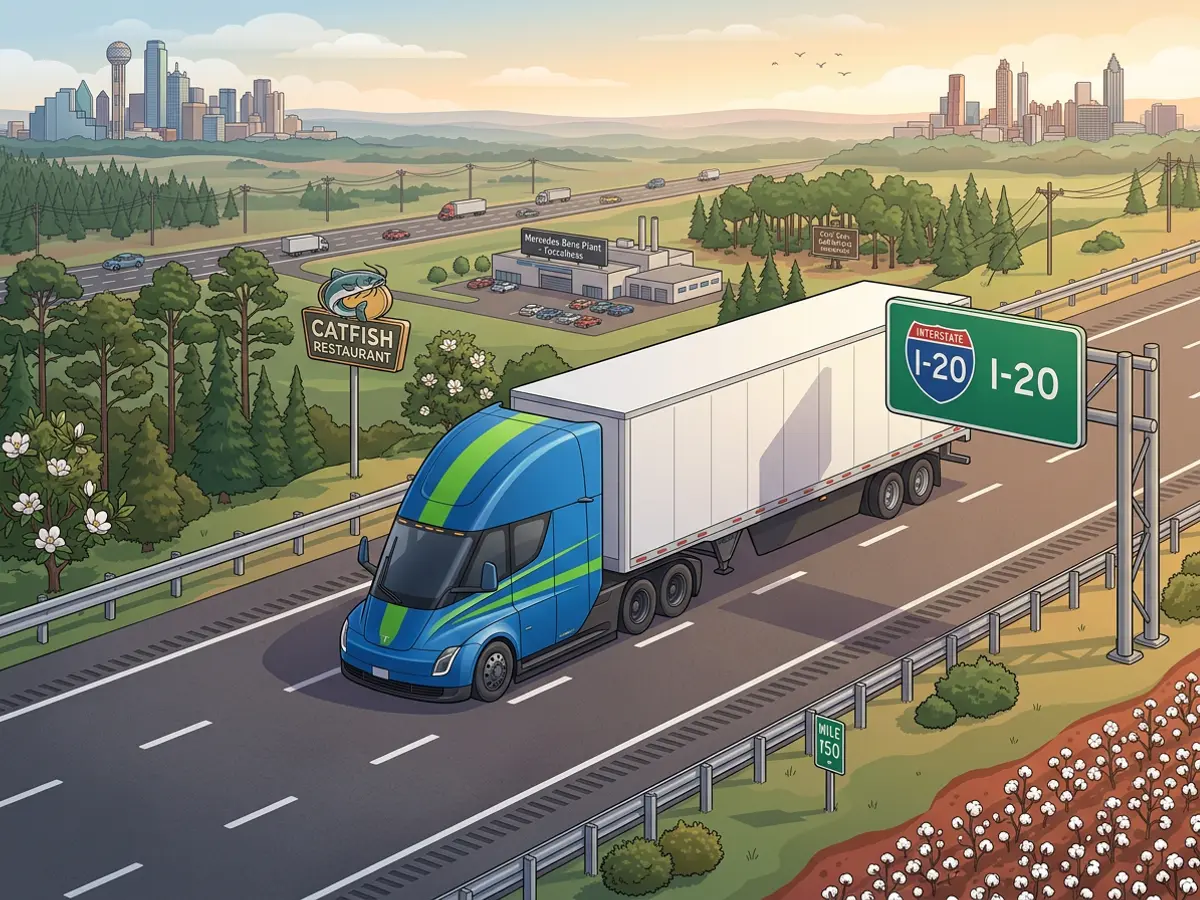
I-20 Southern Corridor
Kent, TX → Abilene, TX → Dallas, TX → Shreveport, LA → Vicksburg, MS → Jackson, MS → Birmingham, AL → Atlanta, GA → Augusta, GA → Florence, SC
States Along the I-20
Texas
Texas is the largest trucking state in America, with over 190,000 for-hire carriers and major freight hubs in Dallas, Houston, San Antonio, and El Paso. The state handles massive volumes of cross-border freight, oil & gas equipment, and consumer goods distribution.
View State Guide →Louisiana
Louisiana is the Gulf Coast freight leader with New Orleans serving as a major international port. The state offers oil & gas, petrochemical, and agricultural freight. Port of New Orleans and Port of South Louisiana create massive import/export opportunities.
View State Guide →Mississippi
Mississippi connects Gulf Coast markets with Memphis and the Southeast. The state offers agricultural freight, casino supply runs, and strategic positioning on the I-55 and I-20 corridors.
View State Guide →Alabama
Alabama is a growing Southeast freight market with Birmingham serving as a regional hub. The state offers automotive manufacturing, steel production, and port access in Mobile. I-65 and I-20 corridors provide strong regional and national connectivity.
View State Guide →Georgia
Georgia is the logistics capital of the Southeast, with Atlanta serving as a major distribution hub. The state offers consistent freight volumes, diverse loads, and access to major markets throughout the Eastern US.
View State Guide →South Carolina
South Carolina is a Southeast freight hub with Charleston serving as a major port. The state offers automotive manufacturing, aerospace, and growing distribution sectors. Port of Charleston provides strong import/export opportunities.
View State Guide →Seasonal Rate Patterns
I-20 carries the Deep South industrial belt freight — auto assembly plants in Alabama and Georgia keep rates stable 10 months of the year. Construction materials spike 12-18% from February through June as Southern building season peaks. Energy sector loads from West Texas (Permian Basin) through Midland-Odessa surge when oil prices rise above $70/barrel — rig equipment and pipe loads hit $3.50-$4.00/mile on flatbed. Holiday retail (October-December) adds a 10-15% bump on dry van eastbound from Dallas distribution centers.
Backhaul Strategy
Eastbound from Dallas is the stronger direction — manufacturing, retail distribution, and energy equipment push rates to $2.70-$3.10/mile. Westbound backhauls from the Carolinas and Georgia to Texas average $2.30-$2.65/mile. Atlanta is the relay pivot: it sits at the I-20/I-75/I-85 junction with the highest freight density in the Southeast. For carriers running west of Dallas, the Midland-Odessa oilfield corridor (90 miles south via I-20 to TX-158) offers premium flatbed loads that justify the detour.
Insider Knowledge for the I-20
The I-20 corridor is underrated — most carriers chase I-10 and I-40, leaving I-20 with better rate-to-competition ratios. The Dallas-to-Atlanta lane ($2.85-$3.10/mile dry van) consistently pays 8-12% more per mile than the equivalent I-10 corridor because fewer carriers run it. Birmingham is an underused relay point — Mercedes-Benz, Honda, and Hyundai all have assembly plants within 60 miles, generating steady auto parts freight. West of Dallas, always carry extra fuel — the 180-mile stretch from Abilene to Midland has limited services.
Frequently Asked Questions
What kind of freight moves on I-20?
I-20 is the Southern manufacturing corridor: Mercedes-Benz SUVs from Tuscaloosa, AL; Hyundai from West Point, GA; Kia from West Point, GA; Honda from Lincoln, AL. Beyond automotive, you have Amazon distribution centers in Dallas and Atlanta, Georgia-Pacific lumber from Mississippi, and Permian Basin oilfield equipment from West Texas. Dry van averages $2.70-$3.00/mile; flatbed with energy loads hits $3.20-$3.80/mile.
Is I-20 a good corridor for new owner-operators?
I-20 is one of the best starter corridors. Lower congestion than I-95 or I-10, consistent freight year-round from the auto plants, and manageable distances between relay points (Dallas-Shreveport: 190 mi, Shreveport-Jackson: 220 mi, Jackson-Birmingham: 150 mi, Birmingham-Atlanta: 150 mi). Our dispatchers often start new carriers on the Dallas-Atlanta lane because the freight is predictable and the rates are strong.
How does the Permian Basin affect I-20 rates?
When oil prices are above $70/barrel, Permian Basin activity floods I-20 west of Dallas with flatbed and step-deck loads carrying pipe, frac sand, and rig equipment. These loads pay $3.50-$4.00/mile but require specialized equipment (tarps, chains, binders). Even dry van carriers benefit — the oilfield pulls flatbed capacity off the corridor, tightening supply for regular freight and pushing all rates up 8-15%.
Run the I-20 With a Pro Dispatcher
Our dispatchers have deep relationships with brokers along the I-20. We find the highest-paying loads, plan relay points, and keep you loaded in both directions.