


Retail & Consumer Goods Dispatch
Retail freight is the backbone of dry van trucking, representing $190+ billion in annual US transportation spend across 12 million truckloads per year. The market is dominated by major distribution center corridors — Walmart alone operates 190+ DCs generating 80,000+ loads per week. Rates average $2.60-$3.10/mile on core lanes, but Q4 holiday surge (October-December) pushes spot rates 25-45% above contract as retailers race to stock shelves for $960 billion in holiday sales.
Seasonality & Timing
When retail & consumer goods freight pays the most
Retail freight builds through Q3 as back-to-school and Halloween inventory flows to stores, then erupts in October-November with holiday restocking. Black Friday week is the single highest-volume week in trucking — spot rates jump $0.40-$0.70/mile in a single week. January is the deepest trough as returns flow backward through the supply chain and retailers destock. The February-March dead zone is the best time to negotiate annual contracts at favorable rates.
Handling Requirements
What it takes to haul retail & consumer goods safely and compliantly
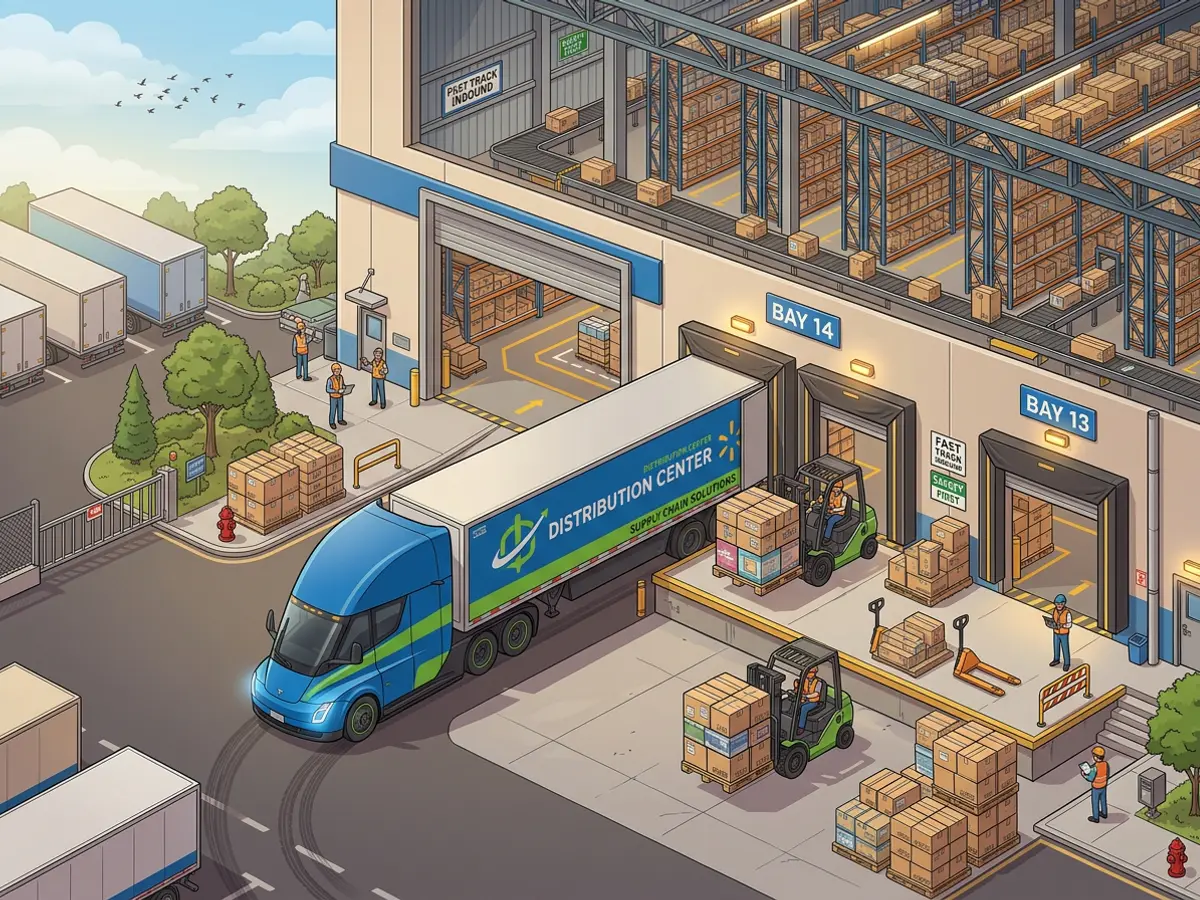
Floor-loaded trailers for many retail DCs — driver-assist unloading adds 2-4 hours per stop
Strict appointment windows at big-box DCs — Walmart, Target, and Home Depot assess $150-$500 late fees per occurrence
MABD (Must Arrive By Date) compliance — failure to meet MABD triggers chargebacks of 3-10% of invoice value
Multi-stop routing common — 2-4 stops per load at $50-$100 per additional stop
Scan-compliant labeling required by most retailers — incorrect ASN/EDI data causes $200+ chargeback per shipment
Compatible Truck Types
Equipment that handles retail & consumer goods freight
Dry Van
The most versatile enclosed trailer, ideal for palletized and floor-loaded freight
View Dry Van DetailsReefer
Temperature-controlled trailer for perishable and temperature-sensitive loads
View Reefer DetailsBox Truck
Smaller enclosed trucks for urban deliveries and last-mile freight
View Box Truck DetailsGeographic Hotspots
Top regions for retail & consumer goods freight volume and rates
Chicagoland (Joliet, Romeoville, Bolingbrook)
The I-55/I-80 corridor south of Chicago is the densest distribution center cluster in North America. Amazon, Walmart, Target, and IKEA operate 50+ facilities within a 30-mile radius. Outbound loads to every US region average $2.70-$3.00/mile, and there is never a deadhead — backhaul freight from the region runs 24/7.
Central NJ (Edison, Cranbury, Exit 8A corridor)
The Exit 8A warehouse district along the NJ Turnpike is the East Coast equivalent of Chicagoland for retail freight. 120+ million square feet of warehouse space serves 65 million consumers within a day's drive. Import deconsolidation from Port Newark generates 8,000+ loads/week at $2.80-$3.20/mile to Southeast and Midwest.
Dallas-Fort Worth (Alliance, Lancaster, Wilmer)
DFW's Alliance corridor is the Southwest distribution hub, with Walmart, Amazon, and Home Depot mega-DCs feeding stores across TX, OK, AR, LA, and NM. Outbound rates average $2.60-$2.90/mile, but Q4 holiday volumes push rates to $3.30/mile on the DFW-to-Atlanta lane.
Lehigh Valley (Allentown, Bethlehem, Easton)
The Lehigh Valley has added 40+ million square feet of distribution space since 2020, making it the fastest-growing DC market in the US. Proximity to NYC (80 miles) and Philadelphia (60 miles) creates high-frequency short-haul runs at $4.00-$5.50/mile, plus long-haul outbound to Southeast at $2.80-$3.10/mile.
Top Lanes for Retail & Consumer Goods
Major freight corridors where retail & consumer goods loads are consistently available
I-10 Southern Corridor
I-95 Eastern Corridor
I-80 Northern Corridor
I-35 Central Corridor
I-5 Pacific Corridor
I-75 North-South Corridor
I-40 Cross-Country Corridor
I-20 Southern Corridor
Retail & Consumer Goods Challenges We Solve
Common obstacles for retail & consumer goods carriers and how we help you overcome them
Appointment scheduling gridlock
Major retailer DCs book appointment slots 3-7 days in advance, and prime morning slots fill instantly. A missed appointment at Walmart can cost $300+ in reschedule fees and 24-48 hours of driver downtime waiting for a new slot.
We maintain direct EDI/portal access for the top 50 retailer DCs and book appointments within 30 minutes of load confirmation. For carriers with consistent lanes, we lock recurring weekly slots that guarantee morning delivery windows. When appointments get bumped, we immediately escalate through our shipper contacts — not through the broker.
Q4 capacity crunch and rate volatility
October-December spot rates can swing $0.30-$0.70/mile week to week. Carriers locked into low contract rates miss out on $30,000-$50,000 in additional revenue per truck during peak season. Conversely, carriers chasing spot loads in Q4 often face 4-8 hour detention at overloaded DCs.
We negotiate Q4 surge clauses into annual contracts — 15-20% rate bumps triggered when DAT National Average exceeds a threshold. For spot-market carriers, we cherry-pick loads going INTO major DC markets (where detention is lower) rather than loads shipping OUT of them during peak.
Driver-assist unloading expectations
Floor-loaded retail loads require the driver to help unload 40,000+ lbs of boxes. This adds 3-5 hours to delivery time and causes driver fatigue and injury risk. Many carriers refuse floor-loaded freight, shrinking the available load pool by 20-30%.
We clearly mark floor-loaded vs. palletized loads in every dispatch and add $100-$200 unloading fees to the rate. For carriers who accept floor-loaded freight, we schedule lighter next-day loads to compensate for the physical toll and target facilities with powered conveyors that reduce manual handling.
Dispatcher Tip
The dispatch trick for retail is understanding the DC reload cycle. Every Walmart DC has a predictable pattern — they receive inbound Monday-Wednesday and ship outbound Wednesday-Friday. If you deliver Tuesday morning, you can usually grab a same-day outbound load and eliminate deadhead entirely. Also, January and February are when the big 3PLs re-bid their annual contracts. If you ran 98%+ on-time all year, you have leverage to lock in rates 8-12% above last year while competitors are desperate for volume.
Retail & Consumer Goods FAQ
Common questions about hauling retail & consumer goods freight
What is the average pay per mile for retail freight?+
How do retailer chargebacks work?+
Is retail freight consistent year-round?+
Do I need a 53ft trailer for retail loads?+
Ready to Haul Retail & Consumer Goods Freight?
Our dispatchers specialize in retail & consumer goods loads. Book a call and we will build a lane plan that maximizes your revenue.