


Produce & Perishables Dispatch
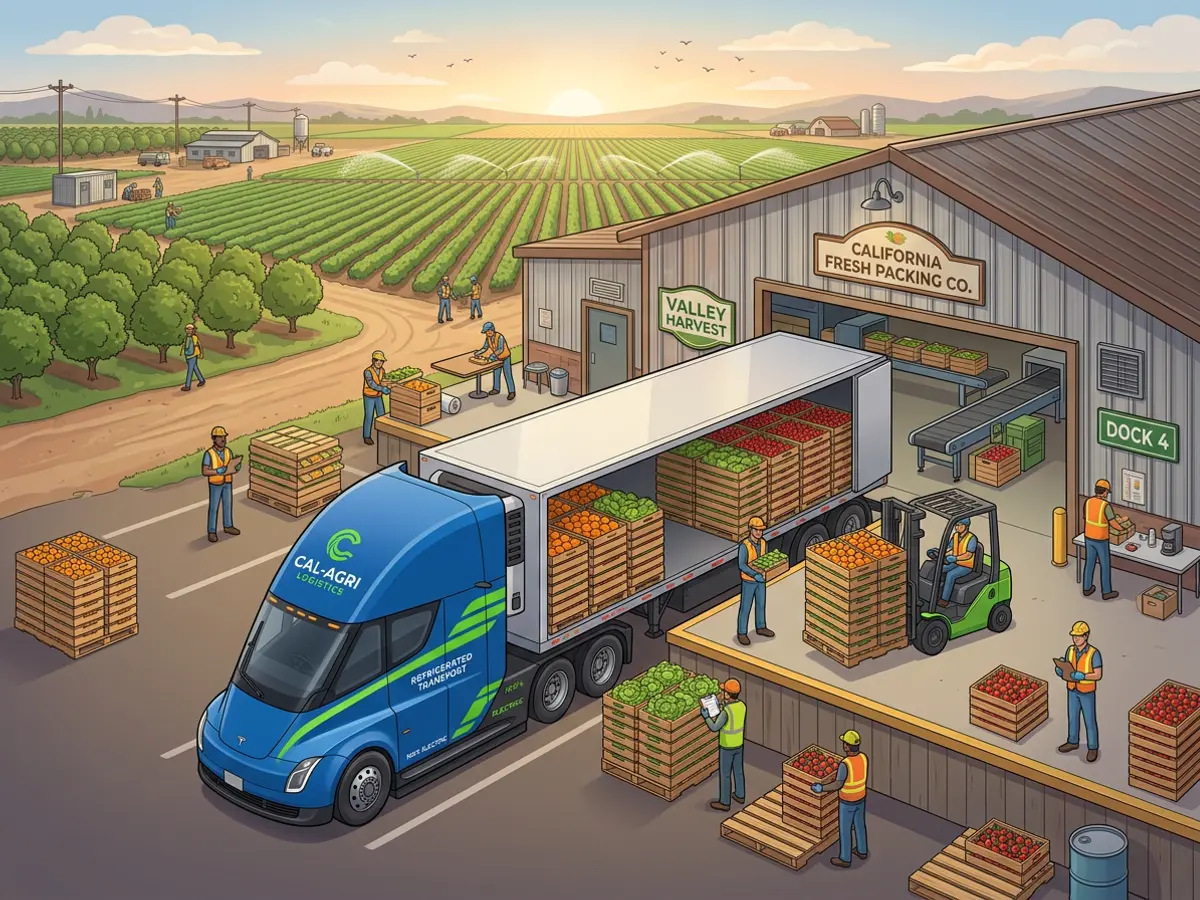
Produce and perishable freight accounts for roughly $48 billion in annual US trucking revenue, with over 3.1 million reefer loads moved each year. California's Central Valley alone ships 250+ commodities across 6.8 million acres of farmland, generating outbound loads that pay $3.10-$3.60/mile during peak harvest from April through October. Florida and Georgia round out the top three origin states, with winter strawberry and citrus runs from Plant City and Vidalia onion season creating rate spikes of 20-35% above baseline.
Seasonality & Timing
When produce & perishables freight pays the most
Produce follows a rolling harvest calendar. California stone fruit peaks May-August at $3.40-$3.60/mile outbound from Fresno. Florida citrus runs December-March, and Georgia peach/onion season fires up April-July. The true dead zone is mid-January to mid-February when Southern Hemisphere imports dominate and domestic loads drop 30-40%.
Handling Requirements
What it takes to haul produce & perishables safely and compliantly
Continuous reefer temperature monitoring between 32-55degF depending on commodity (leafy greens at 32degF, tomatoes at 55degF)
Pre-cool trailer to within 2degF of target temp before loading — shippers will reject a warm box
Pulp temperature checks with a calibrated probe thermometer at pickup and delivery
FSMA Section 204(d) traceability records for all Key Data Elements (KDEs) at Critical Tracking Events (CTEs)
Lumper receipts and USDA inspection certificates for cross-state produce shipments
Air chute management — blocked air chutes cause hot spots that ruin $40,000+ loads
Compatible Truck Types
Equipment that handles produce & perishables freight
Geographic Hotspots
Top regions for produce & perishables freight volume and rates
Central Valley (Fresno, Bakersfield, Salinas)
The single largest produce origin in North America. Over 400 packing sheds within 100 miles of Fresno ship lettuce, grapes, stone fruit, and almonds year-round. Outbound rates average $3.20/mile to East Coast receivers, with peak cherry season (May-June) hitting $3.80/mile.
Central Florida (Plant City, Immokalee, Homestead)
Winter produce capital. Strawberry season (December-March) out of Plant City generates 2,800+ reefer loads/week. Tomato shipments from Immokalee add another 1,500 loads/week November-April. Rates to Northeast markets average $3.00-$3.40/mile.
South Georgia (Vidalia, Tifton, Valdosta)
Vidalia onion season (April-September) is a dispatching goldmine — 6,000+ acres yield loads paying $2.90-$3.20/mile to Midwest distribution centers. Peach season (May-August) from Fort Valley adds volume on the I-75 corridor.
Yakima Valley & Wenatchee
Apple capital of the US. Washington ships 12 billion apples annually, with the Yakima-to-East-Coast lane paying $3.30-$3.70/mile during September-November peak harvest. Cherry loads in June-July command $4.00+/mile due to extreme time sensitivity.
Top Lanes for Produce & Perishables
Major freight corridors where produce & perishables loads are consistently available
I-10 Southern Corridor
I-95 Eastern Corridor
I-35 Central Corridor
I-5 Pacific Corridor
I-75 North-South Corridor
I-40 Cross-Country Corridor
Produce & Perishables Challenges We Solve
Common obstacles for produce & perishables carriers and how we help you overcome them
Temperature claim liability
A single reefer malfunction can destroy $40,000-$80,000 worth of produce in transit. Cargo claims on produce average $18,500 per incident, and carriers with more than two claims in 12 months get blacklisted by major shippers.
We require continuous temperature monitoring with GPS-enabled data loggers and set up automated alerts when temps drift more than 3degF from target. Our dispatchers verify reefer unit service records before accepting any produce load and build 4-hour buffer windows to account for loading delays at packing sheds.
Appointment-free loading chaos
Many produce shippers operate first-come-first-served, meaning drivers can wait 6-14 hours at the dock during peak season. That is $200-$400 in lost revenue per wait, and detention is rarely paid on produce loads.
We track real-time wait times at the top 200 produce shippers and route drivers to facilities averaging under 3 hours. For high-wait shippers, we negotiate $75/hour detention after 4 hours or avoid them entirely in favor of shippers that honor appointments.
FSMA compliance burden
The FDA's FSMA Produce Safety Rule and Section 204(d) traceability requirements add 30-45 minutes of documentation per load. Non-compliance fines start at $13,700 per violation.
Our onboarding process includes FSMA documentation templates and a checklist that covers every required data point. We flag loads from shippers known to have incomplete paperwork so drivers are not caught holding the bag at inspection.
Dispatcher Tip
The real money in produce is not the posted rate — it is the relationships. Build rapport with 5-6 produce shippers in Salinas or Fresno and you will get first-call freight at $3.40+/mile while board rates sit at $2.80. Also, never deadhead out of California. There is always a backhaul from LA or the Central Valley — even if it is a $2.20/mile dry van load, it beats 300 empty miles to Phoenix.
Produce & Perishables FAQ
Common questions about hauling produce & perishables freight
What reefer temperature do most produce loads require?+
How much more do reefer loads pay compared to dry van?+
What certifications do I need to haul produce?+
When is the best time of year to haul produce?+
Ready to Haul Produce & Perishables Freight?
Our dispatchers specialize in produce & perishables loads. Book a call and we will build a lane plan that maximizes your revenue.