


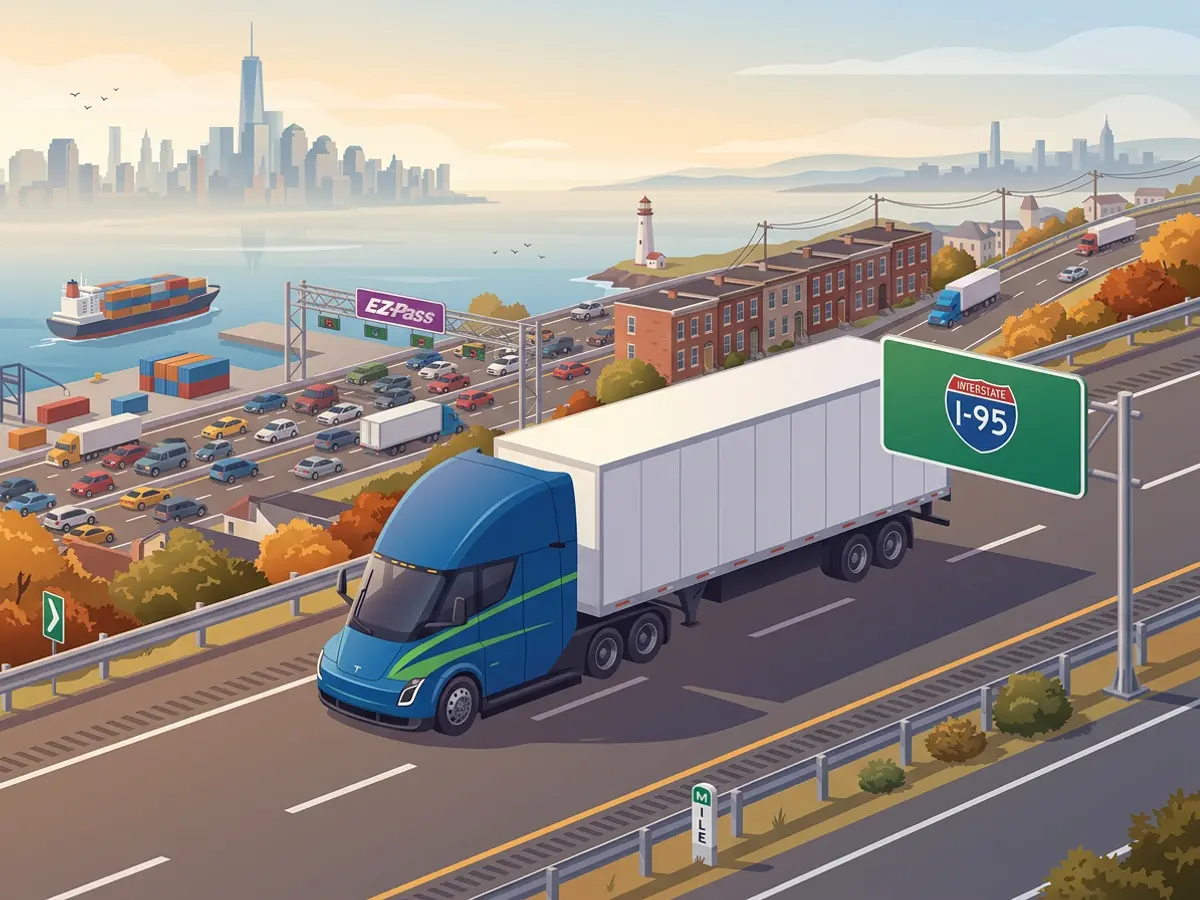
I-95 Eastern Corridor
Miami, FL → Jacksonville, FL → Savannah, GA → Florence, SC → Fayetteville, NC → Richmond, VA → Baltimore, MD → Philadelphia, PA → Newark, NJ → New York, NY
States Along the I-95
Florida
Florida is the third-largest state for trucking, with major freight flowing through Miami, Jacksonville, Tampa, and Orlando. The state serves as a critical distribution hub for Latin American imports and domestic goods heading to the Southeast.
View State Guide →Georgia
Georgia is the logistics capital of the Southeast, with Atlanta serving as a major distribution hub. The state offers consistent freight volumes, diverse loads, and access to major markets throughout the Eastern US.
View State Guide →South Carolina
South Carolina is a Southeast freight hub with Charleston serving as a major port. The state offers automotive manufacturing, aerospace, and growing distribution sectors. Port of Charleston provides strong import/export opportunities.
View State Guide →North Carolina
North Carolina is the Southeast's rising freight star, with Charlotte emerging as a major distribution hub. The state offers diverse freight from textiles and furniture to food processing and tech. Excellent highway infrastructure and port access in Wilmington create strong opportunities.
View State Guide →Virginia
Virginia is a Mid-Atlantic freight powerhouse with Norfolk serving as a major East Coast port. The state offers port freight, government contracting, and technology sectors. I-81 and I-95 corridors provide strong North-South connectivity.
View State Guide →Maryland
Maryland is strategically positioned in the Mid-Atlantic with Baltimore serving as a major port. The Port of Baltimore handles diverse cargo from automotive to bulk commodities. Proximity to Washington DC and Northeast markets creates strong opportunities.
View State Guide →New Jersey
New Jersey is the gateway to the massive New York metro market and Northeast Corridor. The Port of Newark is the largest on the East Coast, creating enormous import/export opportunities. Dense population and proximity to major markets drive consistent high-volume freight.
View State Guide →New York
New York is the largest consumer market in the Northeast with New York City serving as a massive freight destination. The state offers consumer goods, food service, and manufacturing freight. Multiple ports and the massive NYC metro create endless opportunities.
View State Guide →Connecticut
Connecticut serves the dense Northeast corridor with proximity to New York City and Boston. The state offers high-value freight, pharmaceutical distribution, and premium rates typical of the Northeast market.
View State Guide →Massachusetts
Massachusetts anchors the New England market with Boston serving as the region's major freight hub. The state offers high-value pharmaceutical freight, tech equipment, and premium Northeast rates with access to dense population centers.
View State Guide →Dominant Freight on the I-95
Popular Lanes on the I-95
Seasonal Rate Patterns
This corridor never sleeps — it carries 15% of all US freight by value. Rates spike 12-18% in October-November as holiday retail season fills warehouses from New Jersey to Georgia. Florida produce pushes northbound reefer rates up 20-30% from December through March. Summer sees steady demand from beverage distributors, but rates soften 8-12% as capacity loosens.
Backhaul Strategy
Northbound from Florida is the premium lane, especially for reefer ($3.00-$3.50/mile in winter). Southbound backhauls to Florida average $1.90-$2.30/mile — the weakest direction on the East Coast. Smart play: grab southbound loads to Savannah or Jacksonville from the Northeast corridor, then relay into Florida produce for the profitable northbound run. Charlotte and Richmond are strong pivot points with cross-dock freight.
Insider Knowledge for the I-95
Avoid the I-95 corridor through the Northeast (New Jersey Turnpike to Connecticut) on Fridays and Mondays — congestion adds 2-4 hours and burns $80-$120 in extra fuel. Route around via I-81/I-78 instead. Also, tolls from Florida to Maine can hit $120+ one-way if you run the full turnpike route. EZ-Pass with a commercial account saves 15-20% on tolls and eliminates cash-lane delays.
Frequently Asked Questions
What are typical rates on I-95 northbound?
Dry van northbound from Florida to the Northeast averages $2.75-$3.10/mile. Reefer loads carrying produce peak at $3.20-$3.60/mile in winter months. Pharmaceutical loads from the New Jersey/Pennsylvania pharma corridor to distribution centers pay $3.00-$3.40/mile but require temperature-controlled trailers and chain-of-custody documentation.
How bad are the tolls on I-95?
Running the full I-95 from Miami to Maine costs $120-$150 in tolls for a standard 5-axle truck. The biggest hits: New Jersey Turnpike ($42 full-length), Delaware Memorial Bridge ($10), and the Florida Turnpike extension ($18). Get a commercial EZ-Pass — it saves 15-20% and you avoid the cash-lane backup that can cost you 30-45 minutes at each plaza.
Where should I relay on the I-95 corridor?
The three best relay points are Savannah (strong port freight from the Savannah Harbor), Richmond (crossroads with I-64 east-west freight), and the Edison/Newark, NJ area (largest concentration of distribution centers on the East Coast). Our dispatchers can line up next-day loads at any of these hubs so you never sit more than 8 hours.
Run the I-95 With a Pro Dispatcher
Our dispatchers have deep relationships with brokers along the I-95. We find the highest-paying loads, plan relay points, and keep you loaded in both directions.