Lumber & Building Products Dispatch
Lumber and building product freight moves 45 billion board feet of lumber and $180 billion in building materials annually, generating 3.8 million flatbed loads per year across the US. The Pacific Northwest (WA, OR) produces 40% of domestic softwood lumber, with rates from mill to lumberyard averaging $3.40-$4.20/mile on flatbed. Lumber prices are notoriously volatile — random-length lumber futures swung from $350 to $1,700 per thousand board feet between 2020-2024 — and freight volume tracks housing starts with a 60-90 day lag. When lumber prices spike, mills ship everything they can produce and flatbed rates surge 20-30% within weeks.
Seasonality & Timing
When lumber & building products freight pays the most
Lumber freight follows the residential construction calendar. Spring (March-May) is the strongest period as builders break ground on the 1.4 million housing starts projected annually, driving lumber orders 30-40% above winter levels. Summer stays strong through August. Fall (September-October) tapers as framing season ends in Northern states. Winter (November-January) is the slowest, with 35-45% volume drops in Pacific Northwest mills as both production and demand decline. Southern yellow pine mills (GA, AL, MS) run more consistently year-round.
Handling Requirements
What it takes to haul lumber & building products safely and compliantly
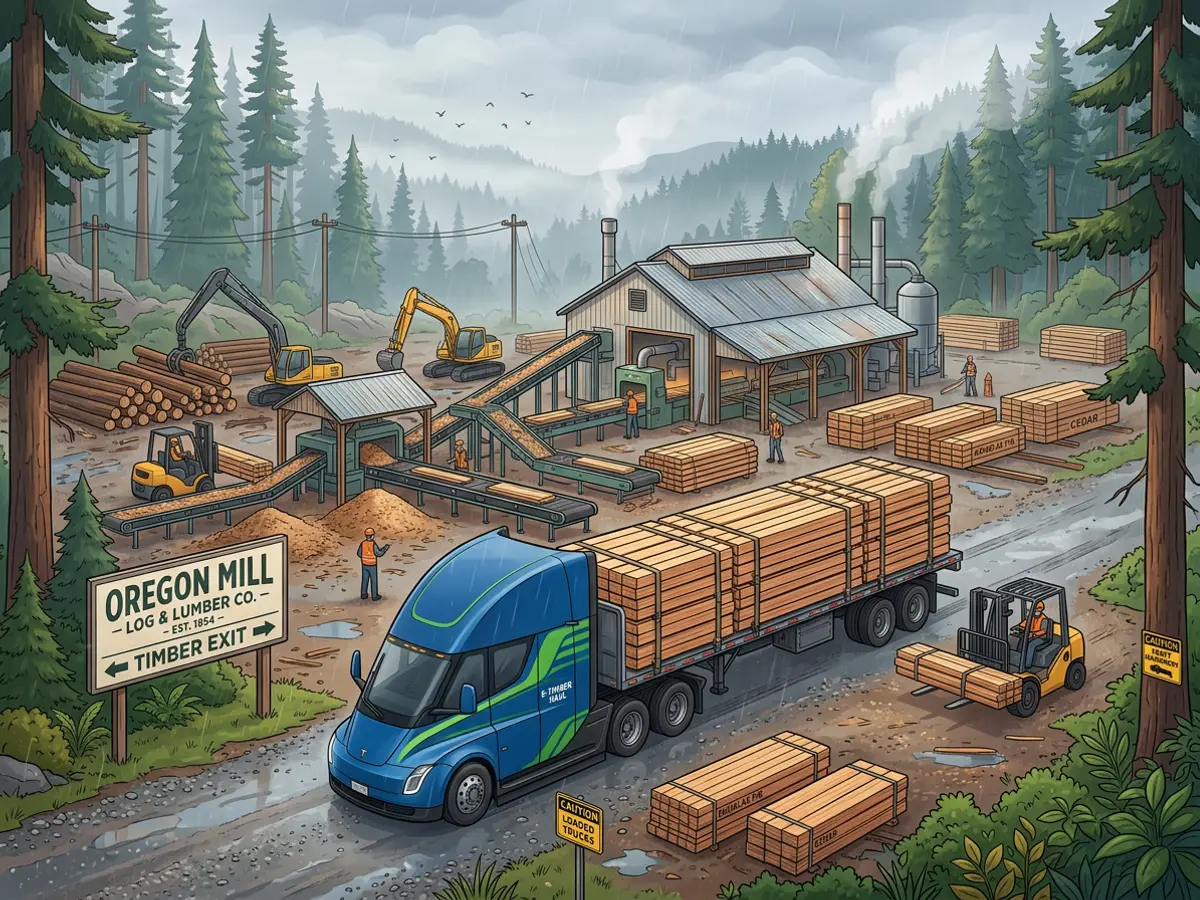
Flatbed with lumber stakes (6-8 per side) and 8ft lumber tarps — untarped lumber exposed to rain loses $5,000-$15,000 in value per load from staining and warping
Securement: 4-inch straps at 10ft intervals minimum, with edge protectors on every strap point to prevent lumber indentation
Weight monitoring — green (undried) lumber loads can run 46,000-48,000 lbs, requiring overweight permits or reduced pallet counts
Dimensional lumber must be loaded flat (not on edge) to prevent bowing during transit — a bowed 2x4 is downgraded from #1 to #2 grade at $50-$80 per thousand board feet loss
Load height management — standard lumber loads stack to 8.5ft, but engineered wood products (trusses, LVL beams) can exceed 10ft requiring oversize permits
Compatible Truck Types
Equipment that handles lumber & building products freight
Geographic Hotspots
Top regions for lumber & building products freight volume and rates
Western WA (Longview, Tacoma, Aberdeen)
Washington state produces 4.5 billion board feet of softwood lumber annually from 200+ mills. The Longview-to-Denver lane (1,300 miles) pays $3.80-$4.40/mile during peak season. Export loads to Port of Tacoma for Asian markets pay $3.60/mile on a 70-mile haul with $200 tarp premium. Winter rain makes tarping critical — a $30,000 load of dimensional lumber can lose 40% of its value from water staining.
South Georgia & Southeast Timberlands
The Southeast pine belt (GA, AL, MS) produces 60% of US Southern yellow pine — the dominant framing lumber for residential construction east of the Rockies. Mills near Waycross and Valdosta ship 5,000+ flatbed loads/week to Northeast lumberyards. Rates to NJ/PA run $3.20-$3.60/mile with year-round volume (Southern mills operate 50+ weeks/year vs. 42-44 in PNW).
Denver Metro & Front Range
Denver is the Rocky Mountain lumber distribution hub, receiving 2,500+ inbound loads/week from Pacific Northwest and Canadian mills. Local distribution to job sites within 100 miles pays $4.50-$5.50/mile (short-haul premium). Engineered wood products (trusses, I-joists) from Denver fabricators to mountain communities pay $5.00+/mile due to challenging delivery access on mountain roads.
East Texas (Lufkin, Nacogdoches, Texarkana)
East Texas timberlands feed 80+ mills producing Southern yellow pine, plywood, and OSB. Outbound loads to Dallas-Fort Worth lumberyards run 250 miles at $3.80-$4.30/mile. Houston-area home building drives 3,000+ loads/week of framing lumber from East Texas mills, with rates of $3.40-$3.80/mile on the 200-mile lane.
Top Lanes for Lumber & Building Products
Major freight corridors where lumber & building products loads are consistently available
Lumber & Building Products Challenges We Solve
Common obstacles for lumber & building products carriers and how we help you overcome them
Lumber price volatility crushes volume
When lumber futures drop below $400/thousand board feet, mills curtail production 20-40% and ship only committed orders. This can happen in 4-6 weeks, stranding flatbed carriers who built their business around lumber lanes. In 2022, random-length lumber fell from $1,300 to $400 in 5 months, wiping out 35% of Pacific Northwest flatbed volume.
We track lumber futures prices weekly and adjust carrier allocations when prices trend below $500. When mill curtailments start, we redirect flatbed carriers to construction materials, steel, or energy loads within 48 hours. No carrier in our network has more than 40% of their book in lumber — the rest is diversified across 2-3 other flatbed categories.
Rain damage and tarping disputes
Untarped lumber exposed to rain for even 30 minutes can develop surface mold and water staining that downgrades the entire load from #1 to #2 grade, reducing its value by $3,000-$8,000. Receivers inspect loads immediately and reject any shipment with visible moisture damage. Tarping a full flatbed of lumber takes 45-60 minutes and is physically demanding.
We negotiate $100-$150 tarp fees on every lumber load and only dispatch carriers with 8ft lumber tarps in good condition (no holes, grommets intact). For drivers who consistently deliver dry lumber, we prioritize them for the highest-paying lanes. In the Pacific Northwest, we schedule pickups for early morning to avoid afternoon rain and route through indoor loading facilities when available.
Green lumber weight problems
Fresh-cut (green) lumber contains 30-80% moisture by weight. A load of green Douglas fir can weigh 46,000-48,000 lbs — 4,000-6,000 lbs heavier than kiln-dried lumber of the same volume. This pushes many trucks over the 80,000 lb GVW limit, especially with sleeper-cab tractors.
We specify green vs. kiln-dried on every lumber dispatch and calculate load weight before booking. For green lumber, we either reduce pallet count by 2-3 pallets or dispatch light-spec day cabs. We also route through states with higher weight tolerances (OR allows 105,500 lbs on designated highways with a $36 permit) to give carriers more payload flexibility.
Dispatcher Tip
The secret weapon in lumber freight is the reload network. Pacific Northwest lumber mills are 50-200 miles from the nearest major city, which means most trucks deadhead in. But there are always backhaul loads if you know where to look — wine and hops from Yakima Valley (WA), potatoes from Eastern WA, hay from Central OR, and electronics from Portland all flow inbound to the PNW. A carrier who deadheads 200 miles to a lumber mill is leaving $500-$700 on the table. Also, build relationships with 2-3 independent mills, not just Weyerhaeuser and Canfor. The independents pay $0.20-$0.40/mile more because they cannot command the volume discounts that big mills use to beat down rates.
Lumber & Building Products FAQ
Common questions about hauling lumber & building products freight
What type of flatbed trailer do I need for lumber?+
How much do lumber loads pay per mile?+
Is lumber freight seasonal or year-round?+
What is the difference between green and kiln-dried lumber for hauling?+
Ready to Haul Lumber & Building Products Freight?
Our dispatchers specialize in lumber & building products loads. Book a call and we will build a lane plan that maximizes your revenue.